
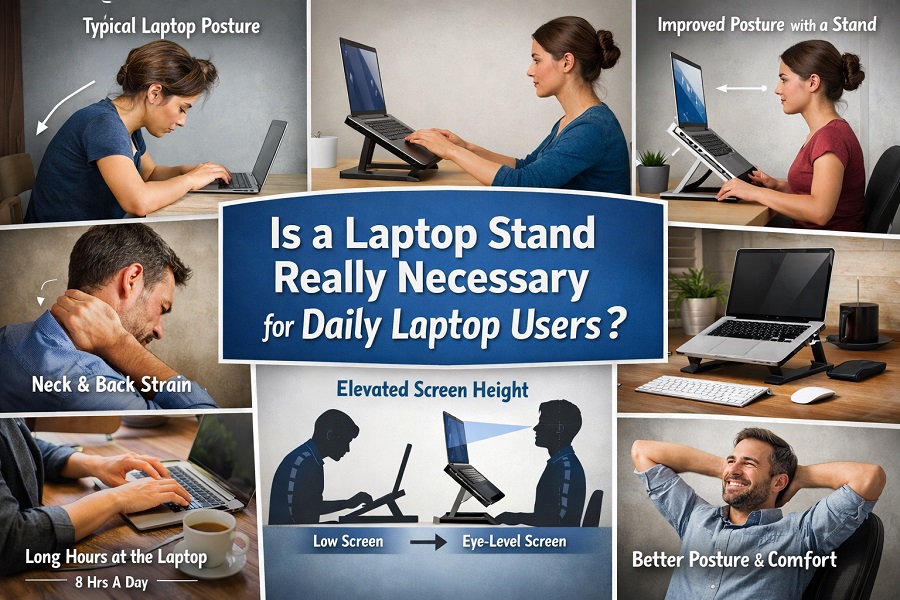
I used to think a laptop stand was just another desk accessory. One more thing people buy and forget about. My laptop worked fine on the table. Screen opened. Keyboard typed. Job done. At least that’s what I thought.
But when you use a laptop every single day, things slowly change. You don’t notice it at first. A little neck pain. A slight bend in your back. Shoulders feeling heavy by evening. You blame work stress. Or bad sleep. Or age. But sometimes, it’s just the way you’re sitting.
So the question comes up. Is a laptop stand really necessary? Or is it optional?
How We Actually Use Laptops
Most daily laptop users don’t sit perfectly. We work on dining tables. On beds. On sofas. Sometimes on the floor. Laptops are portable, so we treat them like they can go anywhere. But our body still has limits.
A laptop screen sits low by default. That means your head bends down. Not a lot. But enough. And you stay like that for hours. Day after day. Over time, your neck and upper back take the load.
You don’t feel it immediately. That’s the tricky part.
The Problem Is the Screen Height
The main issue with laptops isn’t the keyboard. It’s the screen.
Ideally, your screen should be close to eye level. When it’s too low, your neck tilts forward. Even a small tilt increases pressure on the spine. This is not theory. You feel it when you stand up and stretch and hear that little crack in your neck.
A laptop stand lifts the screen. That’s its biggest job. Nothing fancy. Just height.
Once the screen is higher, your head naturally stays more upright. You don’t have to force good posture. It just happens.
What About Comfort?
Some people say, “I’m comfortable without a stand.” That might be true in the short term. Comfort and health are not always the same thing.
Sitting cross-legged on a bed feels comfortable too. But after a few hours, your back tells a different story.
A laptop stand doesn’t feel dramatic. It just removes a bit of strain. Less bending. Less hunching. Less pressure building up quietly.
Does Everyone Need One?
Not necessarily.
If you use your laptop for 20–30 minutes a day, maybe it’s not essential. Checking emails. Watching a short video. Quick browsing. You’ll probably be fine.
But if your laptop is your main work tool, things change.
- Office work
- Freelancing
- Online classes
- Coding
- Content writing
- Designing
- Marketing work
If you sit with a laptop for 4, 6, 8 hours a day, a stand starts to make sense.
Not because it’s trendy. Because your body is involved now.
What Changes After Using a Stand?
Most people notice small things first.
You sit a little straighter.
Your neck doesn’t feel as stiff by evening.
You stretch less often.
Your shoulders relax without you thinking about it.
It’s not magic. Just alignment.
Some people also pair a stand with an external keyboard and mouse. That setup feels more like a desktop. But even without extra accessories, lifting the screen alone helps.
Are There Any Downsides?
Honestly, very few.
It takes a bit of desk space.
You need to adjust your sitting habit.
Very cheap stands can wobble.
That’s about it.
A stand doesn’t slow you down. It doesn’t change how your laptop works. It just changes how you sit with it.
Is It Worth the Money?
Laptop stands are not expensive compared to other tech accessories. And they last a long time. There’s no software update. No battery. No replacement cycle.
You’re basically paying for better posture support.
When you think about how much time you spend on your laptop, it feels reasonable.
So, Is a Laptop Stand Really Necessary?
Necessary is a strong word.
You can live without one. Just like you can drive without adjusting your seat properly. But that doesn’t mean it’s a good idea.
For daily laptop users, a stand is less about convenience and more about care. Care for your neck. Your back. Your long working hours.
You may not feel the benefit on day one. But after weeks and months, your body notices.
And sometimes, that’s enough reason.