
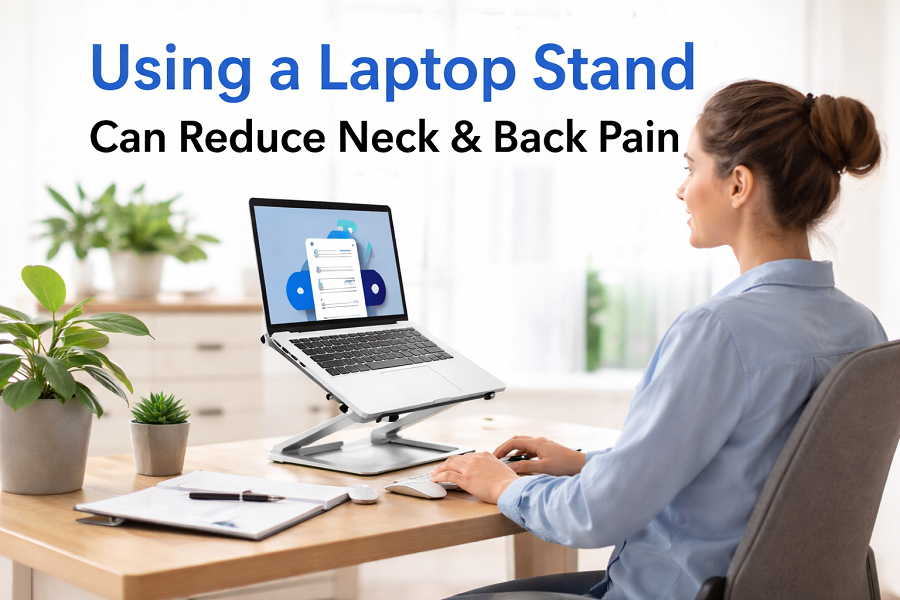
Most of us spend hours every day on a laptop. Work, emails, videos, scrolling. It adds up. And after some time, the body starts to complain. Neck pain. Upper back stiffness. A dull ache in the lower back that just stays there. At first, we ignore it. Then it becomes normal. That’s usually when we start wondering if something is wrong with the way we sit.
One simple thing that often gets overlooked is the height of the laptop screen.
The problem with laptops on a desk
Laptops are designed to be portable, not ergonomic. When you place a laptop flat on a desk, the screen sits too low. To look at it, you naturally bend your neck forward. Just a little at first. But over hours, that forward bend puts pressure on your neck muscles and spine.
The human head is heavy. When it tilts forward, even slightly, the load on the neck increases a lot. This is why many people feel pain at the base of the neck or between the shoulders after a long workday.
Your back also gets affected. When your neck moves forward, your shoulders follow. Then your upper back rounds. Then your lower back loses its natural curve. It becomes a chain reaction.
How a laptop stand changes posture
A laptop stand lifts your screen to a higher level. Ideally, the top of the screen should be close to your eye level. When the screen is higher, you don’t need to bend your neck down all the time.
This small change helps you sit more upright without thinking too much about it. Your head stays balanced over your shoulders. Your shoulders relax. Your spine stays closer to its natural position.
You’re not forcing yourself to “sit straight.” It just happens more naturally.
Less neck strain over long hours
Neck pain is one of the most common complaints among laptop users. Especially people who work from home or use laptops on beds and sofas.
When you use a laptop stand, your neck stays in a neutral position. Neutral means it’s not bent forward or backward. Muscles don’t have to work as hard to hold your head up. Over time, this reduces muscle fatigue.
People often notice that they don’t feel that tightness in the neck by evening. Or the headache that starts from the neck and goes up.
It doesn’t fix everything overnight. But it reduces daily strain, which matters a lot.
Better support for your back
Back pain often comes from poor sitting habits, not just bad chairs. Even with a good chair, if you’re bending forward to see the screen, your back will suffer.
A laptop stand helps keep your torso upright. When paired with a chair that supports your lower back, it becomes much easier to maintain a healthy sitting position.
Your lower back keeps its natural curve. Your upper back doesn’t hunch as much. Over time, this can reduce stiffness and soreness, especially in the mid and lower back.
Encourages healthier work habits
Using a laptop stand often leads to other small improvements. Many people start using an external keyboard and mouse because the laptop is raised. This further improves posture because your arms can rest at a comfortable height.
It also makes people more aware of their setup. They adjust their chair. They take breaks. They stop working from awkward positions like the bed or couch for long hours.
These small habits add up.
Useful beyond office work
Laptop stands aren’t just for office jobs. Students benefit too. Designers, writers, programmers. Even people who use laptops for watching videos or online classes.
If you’re looking at a screen for more than an hour a day, posture matters. Pain doesn’t always show up immediately. Sometimes it takes months. Preventing it early is easier than dealing with it later.
A simple tool with long-term impact
A laptop stand isn’t a medical device. It’s not a cure. But it’s a simple tool that helps your body work the way it’s meant to.
By lifting the screen, it reduces the need to bend your neck. By improving posture, it reduces stress on the back. Over time, this can mean fewer aches, less stiffness, and better comfort during long workdays.
Considering how much time we spend on laptops, small changes like this can make a big difference. Sometimes, it’s not about working less. It’s about working smarter and taking better care of your body while doing it.